
Pages
民航发动机“由窄变胖”的演变
The Evolution of Propulsion Efficiency: A Strategic Analysis of Bypass Ratio Optimization in Civil Aviation
Executive Summary
The history of civil aviation is fundamentally a trajectory of thermodynamic and aerodynamic refinement. At the center of this evolution is the Bypass Ratio (BPR), a metric that has transformed aero-engine design from slender, high-velocity turbojets to the massive, ultra-high bypass turbofans (UHBR) powering modern wide-body and narrow-body fleets. This report examines the transition from internal combustion-dominant thrust to bypass-dominant thrust, analyzing the physical principles, economic drivers, and environmental imperatives that have dictated engine morphology over the last seven decades.
As global aviation moves toward "Net Zero" targets, understanding the limit of bypass optimization becomes critical for strategic fleet planning and OEM (Original Equipment Manufacturer) evaluation.
Methodology & Scope
This analysis synthesizes historical engine performance data, fluid dynamics principles, and market economic trends to evaluate the impact of bypass ratios on aviation sustainability. The scope includes:
- Technical Definition: A granular look at mass flow dynamics.
- Chronological Mapping: Tracking BPR evolution from the 1950s to the 2020s.
- Physics of Propulsion: Mathematical modeling of propulsive efficiency.
- Economic & Environmental Impact: Correlation between BPR, fuel burn, and noise pollution.
Primary Findings: The Morphology of Efficiency
The visual transformation of aircraft engines—from the "pencil-like" profiles of the early jet age to the "barrel-like" diameters of modern high-bypass engines—is not aesthetic; it is a manifestation of the Propulsive Efficiency () formula.
The Definition of Bypass Ratio (BPR)
In a turbofan engine, the bypass ratio is defined as the ratio between the mass flow rate of air bypassing the core engine () and the mass flow rate of air entering the core ():
- The Core (Inner Loop): This air undergoes compression, combustion, and expansion. It provides the energy required to drive the fan and the internal compressors.
- The Bypass (Outer Loop): This air is accelerated solely by the fan and provides the majority of the thrust in modern engines (typically over 80% in high-BPR models).
Historical Evolution
The industry has transitioned through four distinct eras of bypass technology, as illustrated in the following data synthesis:
| Decade | Representative Model | Engine Type | Bypass Ratio (BPR) | Visual Characteristics |
|---|---|---|---|---|
| 1950s | P&W J57 | Turbojet | 0 | Extremely slender, high-velocity exhaust |
| 1960 | RR Conway | Low-Bypass Turbofan | 0.3 | Slightly tapered, introduction of bypass |
| 1970 | P&W JT9D | High-Bypass Turbofan | 5.0 | Bulbous, wider fan diameter |
| 1995 | GE90 | Ultra-High-Bypass | 9.0 | Massive barrel shape, composite blades |
| 2020 | PW1100G | Geared Turbofan (GTF) | 12.0 | Extreme diameter, optimized fan speeds |
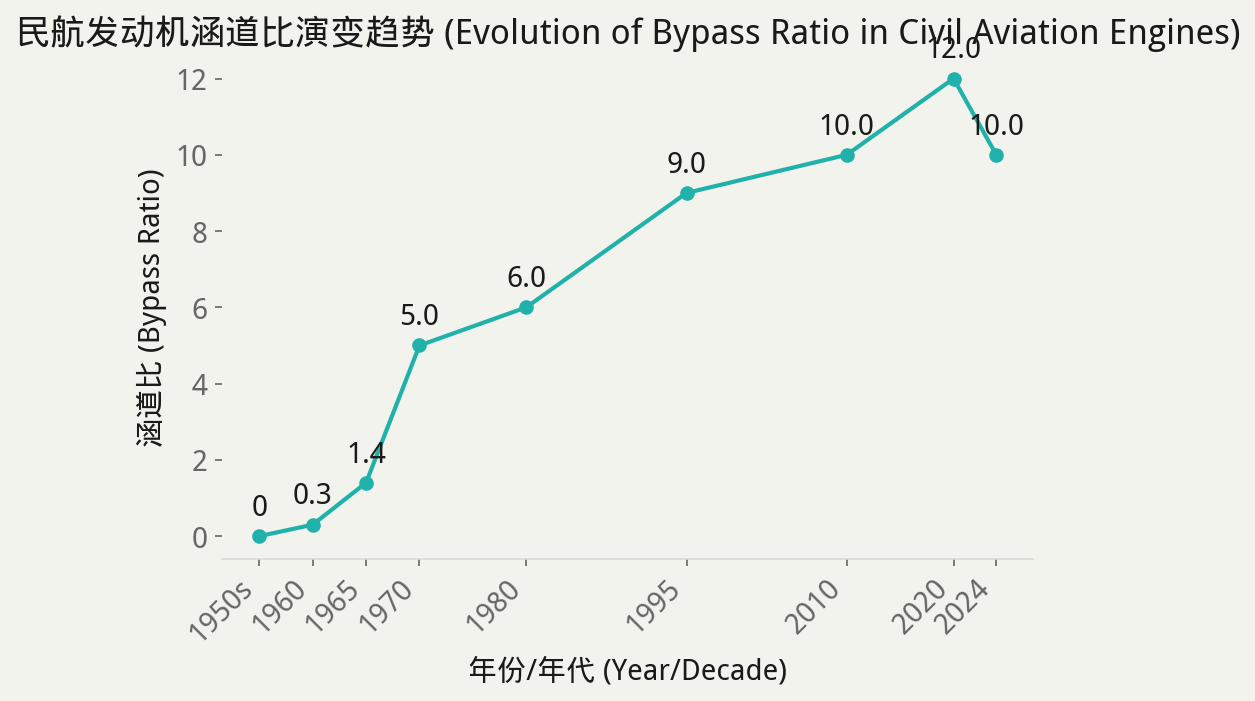
As seen in the visual data, the trend is one of exponential growth in fan diameter. The GE90, once considered the pinnacle of size, has been surpassed by the GE9X, whose fan diameter is wider than the fuselage of a Boeing 737.
Technical Analysis: The Physics of "Moving More Air"
The shift toward higher bypass ratios is driven by a fundamental principle of fluid mechanics: it is more energy-efficient to accelerate a large mass of air slowly than to accelerate a small mass of air quickly.
1. The Momentum Theorem and Thrust
Thrust () is generated by the change in momentum of the air passing through the engine. Simplified, it can be expressed as:
Where:
- is the total mass flow rate.
- is the exit velocity of the air.
- is the flight (intake) velocity.
To achieve a specific thrust , an engineer can either:
- High , Low : Used in turbojets (e.g., Concorde or fighter jets). This results in high kinetic energy loss to the atmosphere.
- Low , High : Used in modern commercial turbofans. This maximizes the utilization of energy for forward motion.
2. Propulsive Efficiency
The propulsive efficiency () measures how much of the kinetic energy generated by the engine is actually converted into useful work for the aircraft:
As the ratio of exit velocity to flight velocity approaches 1, the propulsive efficiency approaches 100%. By increasing the bypass ratio, we increase and decrease for the same amount of thrust, thereby driving significantly higher.
3. Thermodynamic Constraints: The Geared Solution
Increasing BPR is not without technical hurdles. As the fan grows larger, its tip speed increases. If the fan is connected directly to the low-pressure turbine (LPT), the turbine must spin slowly to keep the fan tips sub-sonic, which makes the turbine inefficient.
Conversely, the Geared Turbofan (GTF) architecture, seen in the PW1100G, utilizes a reduction gearbox. This allows the fan to spin at a slower, quieter, more efficient speed while the turbine spins at a high, thermodynamically optimal speed. This "decoupling" has enabled BPRs to jump from 9.0 to 12.0 and beyond.
Strategic Implications for the Aviation Industry
Economic Logic: The Fuel-Cost Correlation
Fuel accounts for approximately 20-30% of an airline's operating expenses. High-bypass engines have revolutionized the economics of long-haul travel.
- SFC Reduction: Specific Fuel Consumption (SFC) has decreased by roughly 1% per year for decades. Modern engines like the GEnx or Trent XWB are over 50% more efficient than the turbojets of the 1960s.
- Mission Capability: High efficiency allows for "Ultra-Long-Haul" (ULH) flights, such as Singapore to New York, which would be physically and economically impossible with low-bypass technology.
Environmental & Acoustic Performance
The environmental benefits of high BPR extend beyond reduction to "Acoustic Shielding."
- Noise Suppression: The high-velocity, hot exhaust from the core is the primary source of jet noise. In high-bypass engines, the slower, cooler bypass air acts as a "buffer" or "insulating blanket" around the core exhaust. This reduces the shear layer turbulence that causes the characteristic "roar" of take-off.
- Regulatory Compliance: Modern engines allow aircraft to meet strict ICAO Chapter 14 noise standards, preventing airlines from being banned from noise-sensitive urban airports at night.
Engineering Trade-offs
While "bigger is better" for efficiency, there are physical limits:
- Weight: Larger fans require larger nacelles and heavier containment rings.
- Drag: The increased frontal area creates more aerodynamic drag.
- Ground Clearance: As engines get "fatter," landing gear must be lengthened, or the engine must be moved forward and up (a challenge famously navigated—and sometimes criticized—in the Boeing 737 MAX design).
Strategic Recommendations
For aviation stakeholders, the following strategic imperatives are identified:
- Fleet Modernization: Airlines should prioritize the retirement of aircraft with BPR < 8.0. The fuel savings from BPR 12.0+ architectures (like the GTF or LEAP) provide a rapid Return on Investment (ROI) even in low fuel-price environments.
- Infrastructure Readiness: Airports must adapt to the physical dimensions of UHBR engines. Maintenance, Repair, and Overhaul (MRO) facilities require updated tooling for fan diameters exceeding 130 inches.
- Investment in Open Fan Technology: The next frontier is the "Open Fan" (e.g., CFM RISE program). By removing the nacelle entirely, BPR can theoretically reach 50:1 to 100:1, potentially offering a further 20% reduction in fuel consumption.
Conclusion
The evolution of the "fat" aircraft engine is a triumph of physics over the brute force of early jet propulsion. By prioritizing mass flow over exhaust velocity, the industry has achieved a paradigm shift in propulsive efficiency. The bypass ratio is no longer just a design specification; it is the primary lever for achieving economic sustainability and environmental stewardship in a carbon-constrained world. As we look toward the future, the continued expansion of the bypass ratio—whether through geared architectures or open-rotor designs—will remain the definitive hallmark of aerospace progress.