Strategic Analysis: The Evolution of U.S.-Iran Confrontation (1953–2026)
Executive Summary
The geopolitical relationship between the United States and the Islamic Republic of Iran has transitioned from a Cold War-era strategic partnership to a state of "controlled war" by the first quarter of 2026. This report provides a comprehensive synthesis of the historical grievances, military doctrines, and economic drivers that have shaped this multi-generational conflict.
As of 2026, the conflict has entered its most volatile phase, characterized by a shift from plausible deniability and proxy harassment to direct state-on-state kinetic exchanges. The primary drivers remain the Iranian nuclear program's critical breakout threshold, the collapse of diplomatic frameworks such as the JCPOA, and the expansion of the "Axis of Resistance" into the Red Sea and beyond. This analysis concludes that the risk of a full-scale regional war is at a fifty-year zenith, necessitating a fundamental reassessment of Western strategic posture in the Middle East.
Rendering diagram...
Methodology & Scope
This report synthesizes internal research, military intelligence, and economic data to map the trajectory of U.S.-Iran relations. The scope of this analysis covers:
Historical Foundation: The pivot from the 1953 coup to the 1979 Islamic Revolution.
Military Engagement Evolution: A chronological examination of naval confrontations, drone warfare, and ballistic missile exchanges.
Proxy Architecture: The strategic depth provided by the "Axis of Resistance."
Economic Forensics: The correlation between oil export revenues, sanctions, and military spending.
2026 Crisis Analysis: The specific catalysts that led to recent direct strikes between the IRGC and U.S./Israeli forces.
I. Historical Foundations: From Pillars to Pariahs (1953–1979)
The contemporary enmity is not merely a product of policy disagreement but is rooted in deep-seated historical grievances and a fundamental clash of governing ideologies.
1.1 Operation Ajax and the "Pillar" Strategy
The modern Iranian narrative of U.S. "imperialism" is anchored in the 1953 CIA-backed coup (Operation Ajax). By overthrowing Prime Minister Mohammad Mosaddegh—who sought to nationalize Iran’s oil industry—and consolidating the power of Shah Mohammad Reza Pahlavi, the U.S. established Iran as a cornerstone of its regional security architecture. For decades, the Shah’s Iran served as a "twin pillar" (alongside Saudi Arabia) to contain Soviet influence.
1.2 The 1979 Pivot and the Hostage Crisis
The 1979 Islamic Revolution replaced a pro-Western autocracy with a theocratic republic led by Ayatollah Khomeini. This transition was marked by the 444-day Iran Hostage Crisis, which served as the "original sin" in the U.S. diplomatic consciousness. The subsequent ideological divergence categorized the U.S. as the "Great Satan" (Sheytan-e Bozorg) and Iran as the vanguard of an anti-imperialist "Resistance" movement. This era established the "Containment" policy that would define the next four decades.
II. Detailed Military Confrontations and Kinetic Shifts
The military dimension of this conflict has evolved from maritime skirmishes in the 1980s to the high-tech, long-range missile exchanges of 2026.
2.1 The Tanker War and Operation Praying Mantis (1988)
The 1980s saw the first major direct naval clashes. During the Iran-Iraq War, the U.S. launched Operation Earnest Will to protect Kuwaiti oil tankers.
The Event: In April 1988, the USS Samuel B. Roberts struck an Iranian mine.
The Response: The U.S. launched Operation Praying Mantis, the largest surface engagement for the Navy since WWII. U.S. forces destroyed the Sassan and Sirri oil platforms and sank the Iranian frigate Sahand.
The Aftermath: The accidental downing of Iran Air Flight 655 by the USS Vincennes in July 1988 remains a central pillar of Iranian military propaganda, justifying their pursuit of asymmetric naval and missile capabilities.
2.2 2019–2020: The Breach of Plausible Deniability
Following the U.S. withdrawal from the JCPOA in 2018, the conflict entered a period of rapid escalation.
RQ-4 Global Hawk Shootdown: In June 2019, Iran’s IRGC used an indigenous 3rd Khordad SAM system to down a U.S. high-altitude drone.
Assassination of Qasem Soleimani: On January 3, 2020, a U.S. MQ-9 Reaper drone killed IRGC-QF Commander Qasem Soleimani in Baghdad.
Operation Martyr Soleimani: Iran’s retaliation on the Al-Asad Airbase involved 11 Qiam-1 and Fateh-313 ballistic missiles. This was a watershed moment: it was the first time Iran launched a direct, acknowledged state-level attack on U.S. forces.
2.3 The 2024–2026 Direct Escalation Phase
By late 2024, the conflict transitioned from "Shadow War" to "Active Confrontation."
Maritime Theater: Through the Houthi movement in Yemen, Iran contested the Bab al-Mandab Strait using anti-ship ballistic missiles (ASBMs), forcing the U.S. into Operation Poseidon Archer.
Operation True Promise (April 2024): Iran launched over 300 drones and missiles at Israel, requiring a massive U.S.-led coalition interception effort.
Early 2026 Direct Strikes: In February 2026, following a lethal drone strike on a U.S. facility in Jordan linked to IRGC leadership, the U.S. and Israel executed coordinated deep-strike operations against IRGC command nodes and missile production facilities within Iranian sovereign territory.
Rendering diagram...
III. The Proxy War Dimension: The Axis of Resistance
Iran’s "Strategic Depth" is maintained through a network of non-state actors that allow Tehran to project power while maintaining a degree of insulation from direct retaliation.
Explosively Formed Penetrators (EFPs); 122mm Rockets.
Liwa Fatemiyoun
Syria
Regional corridor security; Ground troop density.
Iranian-supplied small arms; armored transport.
The evolution of these proxies into "semi-state" actors with ballistic capabilities has fundamentally altered the threat profile for U.S. Central Command (CENTCOM).
IV. Technical Analysis: Economic Warfare and Military Funding
A critical component of the U.S. strategy has been "Maximum Pressure"—the attempt to bankrupt the Iranian state to curtail its military expansion. However, data analysis reveals a complex relationship between sanctions and military persistence.
4.1 Oil Revenue and the "Ghost Fleet"
While U.S. sanctions aimed to reduce Iranian oil exports to zero, Tehran developed a sophisticated evasion infrastructure. By 2025, Iran operated a "Ghost Fleet" of over 350 tankers using ship-to-ship (STS) transfers and "flag of convenience" registries to maintain exports to East Asian markets.
4.2 Correlation of Revenue to Posture
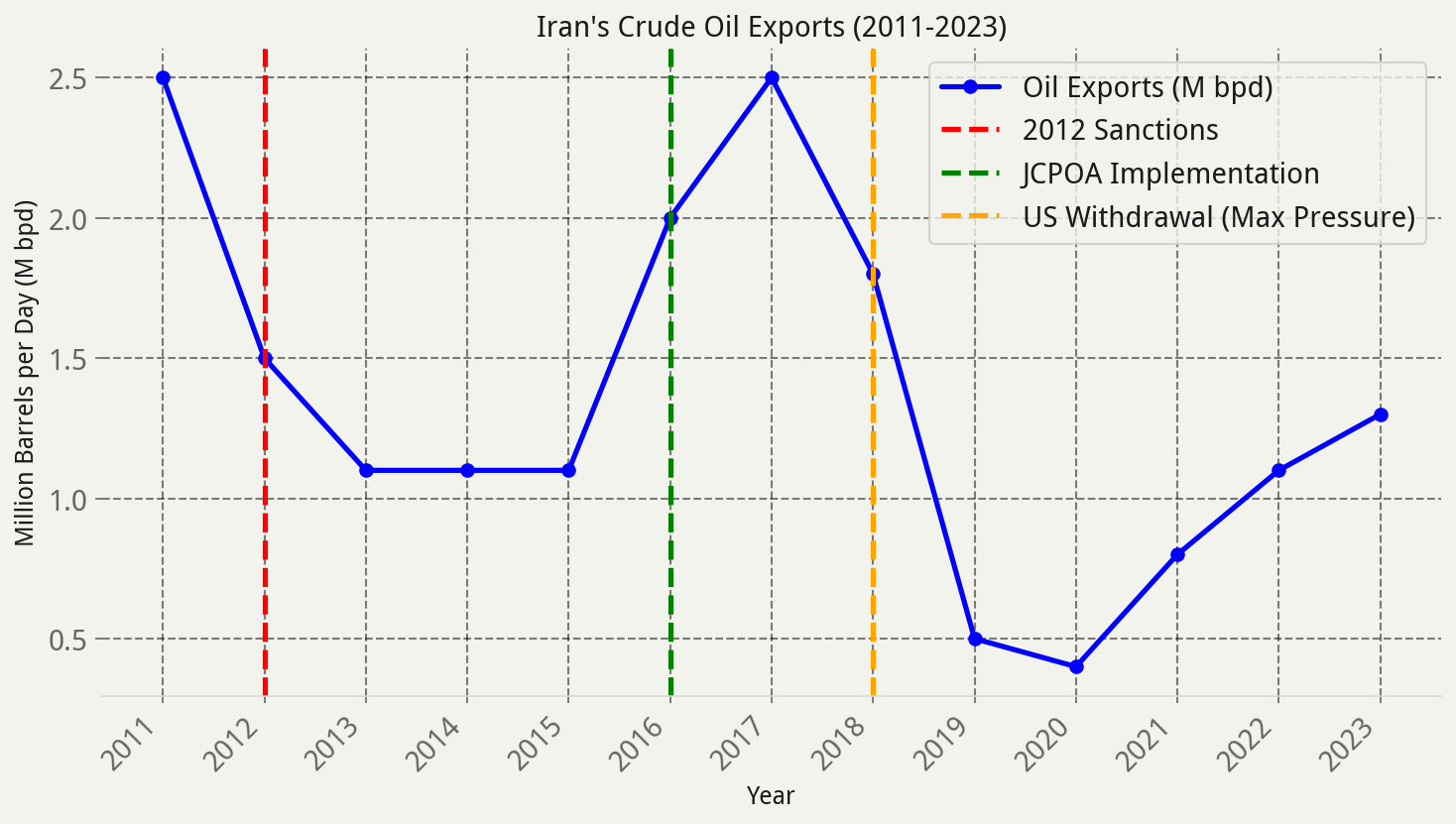
Analysis of export trends shows that while revenue dipped sharply between 2018 and 2020, the regime successfully pivoted by 2021. This recovery in export volume facilitated the funding of the massive drone and missile production programs seen in the 2024-2026 conflict.
iran_oil_exports_trend.png
As illustrated in the data, the dramatic collapse of oil revenues from 95Bin2011toanadirof8B in 2020 was a primary driver for Iran's shift toward more aggressive, low-cost asymmetric warfare. The subsequent rise in military spending (2021–2025) correlates with the recovery of "gray market" oil sales, fueling the development of the Shahed-136 and Fattah-2 hypersonic missile platforms.
4.3 The Nuclear Breakout Factor
The technical progress of Iran’s nuclear program remains the primary "Red Line." As of March 2026, Iran’s enrichment levels (at 60% and 90% purity) have reduced the "breakout time" to less than two weeks. This technical reality has forced the U.S. to transition from a policy of containment to one of active pre-emption.
V. Strategic Recommendations
To navigate the 2026 "Controlled War" environment, the U.S. and its partners must adopt a multi-vector strategy:
Integrated Regional Air Defense (IRAD): Expand the "Middle East Air Defense" (MEAD) alliance to include real-time sensor sharing between Israel, Saudi Arabia, Jordan, and the UAE to counter the proliferation of IRGC loitering munitions.
Maritime Interdiction 2.0: Enhance naval patrols in the Bab al-Mandab and Strait of Hormuz using autonomous surface vessels (ASVs) to identify and intercept IRGC smuggling components destined for the Houthis.
Financial Asymmetry: Shift focus from broad oil sanctions to the specific financial networks facilitating the "Ghost Fleet." This requires high-pressure diplomatic engagement with East Asian transshipment hubs.
Cyber-Kinetic Hybridization: Utilize non-kinetic means to degrade Iran's Command and Control (C2) infrastructure, delaying missile launch capabilities without escalating to full-scale territorial invasion.
Conclusion
The U.S.-Iran conflict has reached a historic inflection point. The era of the "Shadow War" has effectively ended, replaced by a new paradigm of direct kinetic confrontation. The research indicates that despite decades of economic isolation, the Islamic Republic has successfully built a resilient, decentralized military machine capable of contesting global maritime lanes and striking regional targets with precision.
As of March 2026, the strategic landscape is defined not by the avoidance of conflict, but by the management of its intensity. Without a renewed diplomatic framework or a decisive shift in regional power dynamics, the trajectory points toward a sustained state of high-intensity regional confrontation, with the potential for nuclear escalation remaining the most significant threat to global security.
Rendering diagram...
References
1
Support for the Overthrow of Iranian Prime Minister Mohammad ...
The coup came in August 1953. Its success encouraged subsequent U.S. efforts to destabilize governments Washington disliked, and Iranian nationalists used the ...
2
1953 Iranian coup d'état
On 19 August 1953, Prime Minister of Iran Mohammad Mosaddegh was overthrown in a coup d'état that strengthened the rule of Mohammad Reza Pahlavi, the shah ...
3
7 key points in U.S.-Iran relations since 1953 - NPR
The U.S. and Iran have a long history of tensions, including a CIA-led campaign to topple Iran's prime minister in 1953 and the taking of ...
Answer from Google Answer Box: The crisis, which took place during the chaotic aftermath of Iran's Islamic revolution (1978–79) and its overthrow of the Pahlavi monarchy, had dramatic effects on domestic politics in the United States and poisoned U.S.-Iranian relations for decades.
5
The Iranian Hostage Crisis - Short History - Office of the Historian
On November 4, 1979, Iranian students seized the embassy and detained more than 50 Americans, ranging from the Chargé d'Affaires to the most junior members of ...
6
Iran hostage crisis - Wikipedia
The hostage crisis contributed to a dramatic decline in Iran–United States relations. ... After 444 days, it came to an end with the signing of the Algiers ...
7
Operation Praying Mantis - Naval Historical Society of Australia
Operation Praying Mantis was a planned naval response by the United States to Iranian aggression in the Persian Gulf that occurred on 18 April 1988.
8
Operation Praying Mantis - Wikipedia
Operation Praying Mantis was the 18 April 1988 attack by the United States on Iranian naval targets in the Persian Gulf in retaliation for the mining of a US ...
9
The Tanker War | Naval History - June 2025, Volume 39, Number 3
These plans evolved into Operation Praying Mantis, which involved strikes against major Iranian oil platforms and an infamous Iranian warship, the Sabalan. On ...
10
United States withdrawal from the Joint Comprehensive Plan of Action
Answer from Google Answer Box: The withdrawal caused concerns in Iran due to its impact on the economy. On 17 May 2018, the European Commission announced its intention to implement the blocking statute of 1996 to declare U.S. sanctions against Iran illegal in Europe and ban European citizens and companies from complying with them.
11
What Is the Iran Nuclear Deal? | Council on Foreign Relations
President Trump withdrew the United States from the deal in 2018, claiming it failed to curtail Iran's missile program and regional influence. Iran began ...
12
President Donald J. Trump is Ending United States Participation in ...
United States withdrawal from the JCPOA will pressure the Iranian regime to alter its course of malign activities and ensure that Iranian bad ...
13
Iran Air Flight 655 - Wikipedia
Iran Air Flight 655 [a] was an international scheduled passenger flight from Tehran to Dubai via Bandar Abbas that was shot down on 3 July 1988
14
USS Vincennes Shoots Down Iranian Civilian Plane - EBSCO
On July 3, 1988, the USS Vincennes, a US Navy guided missile cruiser, mistakenly shot down Iran Air Flight 655 over the Persian Gulf.
15
The Human-Machine Team Failed Vincennes - U.S. Naval Institute
... Downing of Iran Air Flight 655 on 3 July 1988.” 3. Will C. Rogers and Gene Gregston, Storm Center: The USS Vincennes and Iran Air Flight 655 ...
16
Iran's Proxies Are Out for Themselves for Now - Foreign Policy
It has long been assumed that a regime change war against Iran would trigger its allied militias in Lebanon and Iraq to unleash chaos across ...
17
Iran's 'Axis of Resistance': The proxy forces shaping Mideast conflicts
Iran has built a far-reaching network of allied militias and political movements — from Lebanon and Gaza to Iraq and Yemen.
18
How US strikes on Iran could trigger a wider war with its proxies
A potential U.S. strike on Iran could trigger attacks from Iran's proxy groups, threatening a wider regional war. Experts weigh in on the ...
19
Iranian drones hit the U.S. Embassy in Saudi Arabia, while hundreds ...
The initial U.S.-Israeli strikes killed Iranian Supreme Leader Ayatollah Ali Khamenei and Trump urged Iranians to overthrow their government.
20
The Latest: Strikes escalate across the Middle East as Iran attacks ...
Airstrikes by the United States and Israel have killed at least 787 people in Iran since the start of the war, the Iranian Red Crescent Society ...
21
Iran's MISSILES Pound US Bases Across Middle East- Gulf Under Fire
Following U.S. and Israeli strikes on Iranian territory — and the reported killing of Supreme Leader Ayatollah Ali Khamenei — Iran expanded ...
22
Weighing additional U.S. responses to Houthi Red Sea attacks
This brief explores the advantages and drawbacks of various U.S. policy responses to attacks on commercial shipping in the Red Sea by Ansar ...
23
[PDF] Yemen: Conflict, Red Sea Attacks, and U.S. Policy - Congress.gov
The Iran-backed Houthis launched numerous attacks on international shipping from October. 2023 to December 2024, before pausing these attacks ...
24
US announces naval coalition to defend Red Sea shipping from ...
Egypt and Saudi Arabia notably absent from Operation Prosperity Guardian as more shipping companies forgo route.
25
Iran-backed militia in Iraq said it struck American bases ...
The attack comes in response to a US surprise attack on three Iranian nuclear sites over the weekend. Iran has stated that the missile attacks ...
26
Iran has attacked Americans for decades. Since October ...
Janet Thiessen this was done: The War Powers Resolution requires the president to notify Congress within 48 hours of committing armed forces ...
27
Iraqi Shiite militias join the war between Israel, the US, and ...
The Islamic Resistance in Iraq (IRI), a coalition of Iran-backed Shiite militias, claimed over a dozen drone attacks against “enemy bases in ...
28
Axis of Evil or the Great Satan? Untangling the U.S./Iranian Relationship – njcssjournal
Axis of Evil or the Great Satan? Untangling the U.S./Iranian Relationship – njcssjournal
Anthony Pel...
29
Abqaiq–Khurais attack - Wikipedia
On 14 September 2019, drones were used to attack oil processing facilities at Abqaiq and Khurais in eastern Saudi Arabia. The facilities were operated by ...
30
Two Major Saudi Oil Installations Hit by Drone Strike, and ... - nytimes
A Saudi Aramco plant was attacked in 2019 by a combination of drones and cruise missiles. ... Iranian missile attack in Rishpon, Israel.
31
Meet the Quds 1 - Arms Control Wonk
What made this attack different from other recorded Houthi drone attacks was not only the unprecedented amount of material damage caused but ...
32
Support for the Overthrow of Iranian Prime Minister Mohammad Mosaddeq - The 10 Best and 10 Worst U.S. Foreign Policy Decisions - The 10 Best 10 Worst U.S. Foreign Policy Decisions
Support for the Overthrow of Iranian Prime Minister Mohammad Mosaddeq - The 10 Best and 10 Worst U.S...
33
Did The U.S. Use New Joint Air-To-Ground Missile To Kill ...
Some analysts have identified the munition as an AGM-114 Hellfire missile, a deadly supersonic anti-tank weapon now used extensively by the U.S. ...
34
Memorial for Qassem Soleimani Erected in Lebanon ...
... Soleimani”, a retaliatory strike for the assassination of the Iranian General. ... AGM-114 Hellfire air-to-ground missiles. The Hellfire an anti- ...
35
Žs Constitutional Authority to Strike Foreign Military Officers ...
27 In application, reasonable minds can disagree as to whether a specific targeted killing should be considered an assassination. Regardless of ...
36
What Is the Iran Nuclear Deal? | Council on Foreign Relations
What Is the Iran Nuclear Deal? | Council on Foreign Relations
[Skip to content](#content)
[](https:/...
37
Operation Poseidon Archer: Assessing one year of strikes on Houthi ...
The Houthis began attacking commercial shipping on 19 November 2023, and claimed their first attack on a US warship on 9 January 2024. The ...
38
The Houthis Must Decide: Join Iran's War Against the US and Israel ...
A Houthi spokesperson described the attack as “legitimate” and denied many ships passage through the Red Sea, including Israeli-linked shipping.
39
Houthi Shipping Attacks: Patterns and Expectations for 2025
Two experts offer a detailed infographic and accompanying analysis to chart attack trends over the past year and forecast what's in store for the Red Sea and ...
40
2026 Iran conflict - Wikipedia
Beginning on 28 February 2026, Israel and the United States have been engaged in coordinated joint attacks on various sites in Iran, which has started a ...
41
A timeline of tensions over Iran's nuclear program as talks with ... - PBS
Feb. 6, 2026: Iran and the U.S. hold indirect nuclear talks in Oman, with the head of the U.S. military's Central Command also coming. Feb.
42
How the US war with Iran is playing out around the Middle East
ABU DHABI—Following the joint US and Israeli strikes on Iran, Iran launched retaliatory missile and drone attacks against US military bases ...
43
Tracking the rapid US military build-up near Iran - Al Jazeera
As tensions between the US and Iran rise, we examine the military assets Washington has deployed to the Middle East in recent days.
44
2026 United States military buildup in the Middle East - Wikipedia
Beginning in late January 2026, the United States carried out its largest military buildup in the Middle East since the 2003 invasion of Iraq, deploying air ...
45
Almost all US bases hit by Iran: Is America unable to safeguard its ...
Iran's Islamic Revolutionary Guard Corps escalated its rhetoric by claiming it had directly struck a major US naval asset in the Gulf. “The US ...
46
Dilemmas of Defense: The U.S. Role in the Iran-Israel Conflict
U.S. Iran Israel. On April 13, 2024, the Islamic Republic of Iran carried out an unprecedented operation, launching hundreds of drones and ...
47
Israel-Iran Conflict, U.S. Strikes, and Ceasefire | Congress.gov
On June 13, 2025, Israel began a major military operation against Iran, including air strikes and reported covert action.
48
The Latest: War spirals further as US and Israel exchange strikes ...
The war in the Middle East has spiraled further as Israel and the U.S. pounded Iran, while Tehran and its allies hit back.